
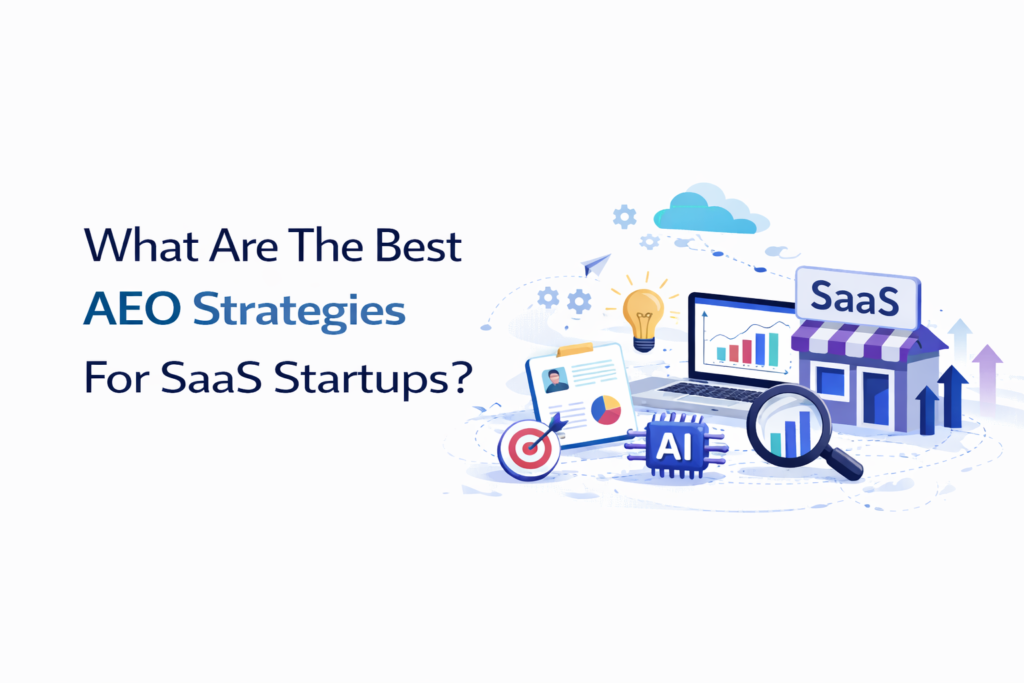
So you built an amazing SaaS product. For this, you spent late nights coding and early mornings debugging. But the hard part is getting people actually to find it.
It is tough out there because the search landscape is shifting fast. This is why people used to care a lot about Google keywords and backlinks. So, now we have to worry about AI.
AI-powered search engines like ChatGPT, Gemini, and Perplexity are changing how people find software. They do not just give a list of blue links, but they give direct answers also. So if your startup is not part of that answer, you are basically invisible.
This is where answer engine optimization (AEO) comes in. It is about making sure you are seen.
What is Answer Engine Optimization (AEO)?
Think about how you use Google these days. Do you write the best project management software and click ten links? Obviously not. But you ask questions like, What is the best project management tool for small remote teams? And expect to get a direct answer.
Answer engine optimization (AEO) means shaping your content so that AI engines can easily find it and serve it up as an answer. It is different from traditional SEO. Because SEO is about ranking a page. At the same time, AEO is about ranking an answer.
Traditional SEO focuses on:
- Keywords
- Backlinks
- Click through rates
AEO focuses on:
- Conversational queries
- Direct facts
- Authority
AI-powered search engines are hungry for data. They want to be the expert. They don’t want to send users away to your site unless they have to. They want to answer the user right there.
For SaaS startups, this is huge. As you are not just fighting for a place on page one. But you are fighting to become the main source of truth. If an AI recommends your tool as the best solution for building trust, you win instantly.
Why is AEO Crucial for SaaS Startups?

SaaS startups face a unique problem. You are mostly fighting giants like Salesforce or HubSpot because they have millions of pages and endless budgets. This is why you cannot beat them on volume.
But you can beat them on specificity. The AI-driven search engines love specific answers. So they love long tail keywords that solve small niche problems. For that reason, this is your playground. Even Adam Audette says:
“Today it is not about getting the traffic, it is about getting the targeted and relevant traffic.”
About 50% of all searches end with no clicks. People see an answer right in the search and leave. If your answer is missing, you lose that lead.
Featured snippets and voice search optimization matter most here. When someone asks Siri, what is the most affordable CRM for startups? You want your name said, not your competitor.
Some SaaS companies do this well because they do not just write blogs; they also build knowledge bases for AI to read. And they answer questions clearly, so the AI has no choice but to cite them.
How to Optimize Your SaaS Website for AI-Powered Search Engines

So how do you do it? It is not magic, but clarity and structure.
Speak the Robot’s Language
You need to make it easy for bots to understand your site. For this, use structured data and schema markup.
So think of a schema like labels on your code. You tell the AI that this is a price, a review, and a software application. Without schema markup, the AI has to guess, and it hates guessing.
Use the SoftwareApplication schema on your product pages. Because it tells AI-powered search engines exactly what your tool does, how much it costs, and what operating system it runs on.
Target the Right Questions
Stop targeting generic keywords like email marketing because you will never rank.
Focus on conversational queries as people talk to AI like a friend, and ask complete questions.
- Try what the best SaaS marketing strategies for early stage startups are, instead of just SaaS marketing.
- Use which accounting software integrates best with Stripe for SaaS, not just accounting software.
These are long tail keywords as they have Fewer searches but more intent. So people asking these questions are ready to buy.
Get Ready for Voice
Voice search optimization is real, as more people use voice, because when we speak, we are less formal.
Your content should sound natural. It should feel like a human answering a question. To check this, read your content out loud. If you stumble, it is too complex. Then keep it simple.
Mobile First is Non-Negotiable
If your site is slow on mobile, forget about ranking. AI-driven search engines prioritize user experience (UX). If your site takes five seconds to load, the AI assumes it is of bad quality. So make sure your site is fast and mobile friendly.
How to Create High Quality, AI-Friendly Content for SaaS Startups

You cannot pack keywords onto a page and hope for leads because the rules have changed. So you need to focus on search intent. And what does the user want right now?
If someone searches for AI search optimization for SaaS, they want action steps, not history lessons about AI. Also, they want to know what to do.
Answer the Question Directly
Do not hide your answer. If your headline asks a question, then answer it in the first lines. AI bots want the answer right away. If you make them dig, then they will skip your site.
Use this structure because Google uses this style more for featured snippets.
- H2 – What are the answer engine optimization tips?
- Paragraph – Answer engine optimisation tips involve structuring content to answer specific user queries directly.
Use Formats AI Loves
AI works best with structure.
- FAQs – A gold mine for question and answer format
- Lists – Bullet points are easy for bots to read
- Tables – Best for comparisons
Traditional SEO vs AEO
| Feature | Traditional SEO | Answer Engine Optimization (AEO) |
| Goal | Rank on Page 1 | Be the Direct Answer |
| Target | Keywords | Conversational queries |
| Device | Desktop/Mobile | Voice/Chatbot |
| Success Metric | Traffic | Citations/Snippets |
Using these formats, you are spoonfeeding the AI and making its job easier. When you do this, you increase your SaaS visibility fast.
How to Leverage Knowledge Graphs and Featured Snippets
You may have heard about knowledge graphs. It sounds complicated, but it is simple.
It is a huge web of facts that Google and other search engines use to understand the world and connect things. Like, Elon Musk is connected to Tesla and SpaceX.
You want your SaaS startup to become part of this web.
How to Get Into the Knowledge Graph
Show you are real.
- Get listed on – Crunchbase, G2, and Capterra. These are trusted sources.
- About Us Page – Be very clear about who you are and what you do.
- Social Profiles – Link them all together.
When you are in the Knowledge Graph, AI knows you are legit.
Chasing Featured Snippets
Featured snippets are position zero because they appear above the first search result.
To get them, you need to be concise.
- Check People also ask for your target keywords.
- Write an H2 that matches their question perfectly.
- Write a 40-50 word answer directly below it.
This way, you become the source AI grabs. Also, use structured data to give yourself an edge.
How to Measure the Success of Your AEO Strategies
How do you check your progress? It is tricky because standard analytics rarely show pure AI traffic. Track different KPIs like:
- Featured snippet rankings – Are you showing up in those boxes?
- Voice search traffic – Hard to see directly using Search Console, and look for natural question queries.
- Brand mentions – Is ChatGPT or Gemini saying your name in answers?
Tools like SEMrush and Ahrefs can track your featured snippets. And Google Search Console tells what queries drive views. So check for long tail keywords in traffic. If you find question based searches bringing in traffic, your AEO is working.
Never stop updating because AI changes every week. So keep testing new questions and tune your schema markup again and again. As the marketing expert Neil Patel says,
“SEO is a race, not a sprint.”
The same applies to AEO. You have to keep moving.
How to Get Started with AEO for Your SaaS Startup
Ready to move? Do not try to do everything at once, you will burn out. Instead, use these simple steps.
Step 1 – Audit Your Content
Review your top pages. Are you answering questions directly? If not, then rewrite the beginnings. Also, add structured data on main product pages.
Step 2 – Find Your Questions
Ask the sales team about what customers ask them most, and look at your support tickets. These are the real conversational queries your audience cares about.
Step 3 – Create a FAQ Section
Build a strong FAQ page. Use schema markup, and cover common objections and questions. FAQs are easy for AI-powered search engines to understand
Step 4 – Optimize for Mobile
Test your site speed. Slow fixes are needed right away because Google hates slow sites. Start small, and pick five questions that matter. Then optimize for those. And once you win, add more.
Key Statistics to Remember
- According to Inkwood Research, the AI in marketing could reach $82.7 billion by 2028.
- Voice commerce hit $66.5 billion in 2024 and is projected to surpass $80 billion soon. This is why people are buying with their voices, not by typing.
If this whole strategy feels a bit overwhelming to start, Cleveranks guides the process well, so your team will not get stuck.
Key Takeaways
Before leaving, read the key takeaways of the content.
- AEO is now critical for SaaS startups as AI-powered search engines take over.
- Always use structured data and aim for conversational queries so bots can understand your information clearly.
- Answer specific questions in your content simply; this is the best path to win featured snippets.
- Track progress in a new way that focuses on snippets and user intent above classic traffic numbers.
FAQs
What is the Difference Between AEO and SEO?
Answer engine optimization (AEO) focuses on providing a single, direct answer for AI-powered search engines and voice assistants. SEO targets ranking positions on traditional search engine results pages. AEO is about precise answers, while SEO is often about broad visibility.
How Can SaaS Startups Benefit From AEO?
AEO helps SaaS startups jump the line. If you optimize for featured snippets and conversational queries, you can get visibility without needing the massive backlink profile of a giant competitor. It drives highly qualified leads who are asking specific questions.
What Tools Can I Use for AEO?
You need a combination of tools, such as Google Search Console, for seeing queries. SEMrush and Ahrefs help track rankings. Use a schema markup generator to create the code for your site. And tools like AnswerThePublic are great for finding the questions people are asking.

