
So you have nailed your SEO strategy, right? Your blog is pumping out content and ranking for keywords. But wait, because the game has changed. We are not just dealing with ten blue links anymore. AI-driven search engines are taking over, and they play by different rules.
If you are a SaaS founder or marketer and you ignore this shift, you leave money on the table. This is where AEO comes in. It stands for answer engine optimization. It is all about being the answer, not just a link. AI models like ChatGPT and Google Gemini aim to provide users with a direct solution.
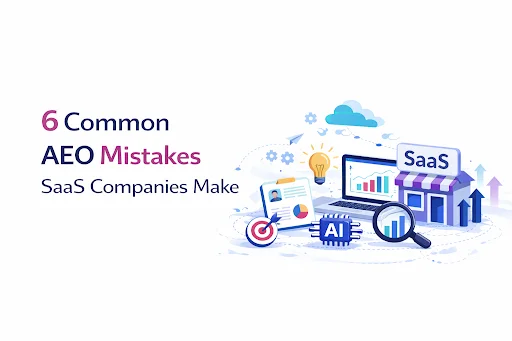
If your content is not set up for this, you will be invisible. We see SaaS companies making the same slip ups over and over again. So it is time to fix that. In this article, you will see 6 common mistakes SaaS companies make and how to fix them so you can win at AI search optimization.
What is AEO and Why Does It Matter for SaaS Companies?
Let us make it easy. SEO gets you seen on the page, while AEO puts you in the answer box. AI driven search engines are meant to give users instant satisfaction. They read the web and put together an answer so the user does not have to click through ten links.
For SaaS companies, this is huge. Your potential customers ask complex questions, such as what the best CRM is for small startups or how to automate payroll. When you optimize for AI driven search engines, your brand can become the trusted authority that the AI recommends.
This builds massive trust. It also attracts qualified traffic because the user already knows you can help. According to early 2025 data from SE Ranking, AI Overviews appeared in about 16% of all U.S. desktop searches. This is a big chunk of traffic you do not want to miss.
Plus, AI search optimization tends to lead to higher user engagement since you are answering questions up front.
Mistake 1 – Ignoring User Intent in Content Creation
This mistake keeps showing up in common SEO mistakes for SaaS. Companies get stuck talking about the product features. They put out endless posts on dashboard designs and clever widgets, but forget the real human on the other side looking for help.
User intent optimization is the backbone of AEO. You need to know why someone searches for that topic. Are they looking to buy? Are they just learning? Or is someone searching for invoice software pricing? When they search these means, they are ready to buy. And if the search is how to make an invoice, it means they are learning.
If you ignore user intent optimization, the AI will ignore you. It wants the best answer that matches the specific intent. To fix this, you need to map content to your buyer journey. Do not just push product pages. Instead, solve the problem first.
User intent optimization means making guides for learners and making your product pages super clear for buyers. This is why your goal is to be useful, not just loud.
Mistake 2 – Neglecting Structured Data and Schema Markup
This sounds technical, but just stick around. Robots need help understanding your content. Structured data acts like a label printer for a web page. It tells the search engine that this is a price or that this part is a review.
Structured data implementation matters a lot for AEO, as the AI engines like simple, clean labels. If you skip structured data implementation, you make it so much harder for search engines and AI to know what you do.
For SaaS, you should use relevant schemas. Use the SoftwareApplication schema to describe your tool. Also, use the FAQPage schema for your help section. Structured data implementation lets you show up in rich snippets and AI summaries. This quick technical fix pays back fast. So do not skip structured data implementation if you really want to rank your pages.
Mistake 3 – Overlooking Voice Search Optimization
People now talk to their devices all the time. Like, they ask Siri what is the best project management tool? When you speak, you use different words than when you type because you use natural language and longer phrases.
Voice search optimization helps you catch these conversations. Many SaaS sites are just too stiff because they read like old manuals. To win at voice search optimization, you need to sound like a real person.
Use long tail keywords that feel like real questions. Do not just aim for HR software, but target what HR software is best for remote teams. This connects with how people actually speak.
Voice search optimization means keeping your answers concise. So voice assistants use short answers that they can repeat back to users. Make sure your voice search optimization uses lots of questions like how to and what is. This is what people are asking every day.
Mistake 4 – Failing to Optimize for Featured Snippets
You know that box at the top of Google that gives you the answer right away? This is a featured snippet. And guess what? AI models love them. If you can rank for featured snippets, you are halfway to winning the AEO game.
A big common SEO mistake for SaaS is not formatting content for these snippets. You put the answer in a long paragraph, or you write a wall of text.
To fix this, you need to structure your content better. For this purpose, use bullet points and numbered lists because AI loves lists. Also, use tables to compare data and answer the main question right after the heading.
Featured snippets are often just direct answers to direct questions. If you want to grab those featured snippets, keep it simple and scannable. Featured snippets are the low hanging fruit of AEO.
Mistake 5 – Not Updating Outdated Content
The SaaS world moves fast. So, a 2021 post about the best marketing trends is useless today. The AI engines prioritize fresh, accurate information. If your site is full of old data, you lose content relevance.
SaaS website ranking depends on trust. If an AI sees that your content is three years old, it might skip you over a fresher source. So keep your content relevance high by doing a regular blog audit.
Go back to your top performing posts and update them by adding new stats. Then check your links. And update your screenshots if your UI has changed. Maintaining content relevance signals to the AI that you are still active and authoritative. It helps maintain your SaaS website ranking over time. Do not let your content rot.
Mistake 6 – Ignoring Mobile and Page Speed Optimization
We live in a mobile world. If your site is slow, users leave, and the AI notices it. Your SaaS website ranking will sink if your performance is poor.
SaaS content marketing errors often involve focusing only on the words and forgetting the experience. The heavy images and bad code slow you down. So, a slow site is a bad answer.
Use tools like Google PageSpeed Insights to check your score. For this purpose, make sure your site is mobile friendly and compress your images. SaaS content marketing errors, like a slow site, are easy to fix but deadly if ignored.
Speed matters for SaaS website ranking. So if you are fast, you are usable. And if you are usable, you are a good answer.
How to Avoid These AEO Mistakes and Improve Your SaaS Website’s Ranking
Avoiding these common fails is not rocket science. All it takes is a shift in thinking. Do not write for old robots, but start writing for new smart assistants. And put your user first with SaaS AEO strategies.
Here is your checklist:
- Focus on user intent optimization every time you write content.
- Go all in on structured data implementation for the whole site.
- Write like a person for voice search optimization.
- Use bullet points, lists, or tables to capture featured snippets.
- Keep your content relevance up with routine updates.
- Fix your technical issues to boost your SaaS website ranking.
Even Lily Ray, a VP of SEO Strategy and Research at Amsive, says:
“Focus on building an authoritative, respected brand known for providing high-quality, original, trustworthy content, leveraging multiple platforms and modes of content to convey your message.”
By avoiding these SaaS content marketing errors and following solid answer engine optimization tips, you will set your company up for long term success.
If you need a partner to help you navigate this new landscape, Cleveranks is a great option to look into. But the main thing is to start now.
Key Takeaways
Before leaving, read the key takeaways from the article:
- AI search optimization is essential for SaaS companies to stay competitive in AI-driven search engines.
- Common SEO mistakes for SaaS include ignoring user intent and neglecting structured data.
- Failing to optimize for voice search optimization and featured snippets costs you visibility.
- Regularly updating content maintains content relevance and ensures mobile optimization is critical for AEO success.
- By avoiding these mistakes and implementing answer engine optimization tips, SaaS companies can improve their visibility and user engagement.
FAQs
What is the Difference Between AEO and SEO?
The main difference is the goal. SaaS AEO strategies focus on being the single best answer for AI-driven search engines, while SEO targets a position on a search results list. AEO is about synthesis and direct answers, while SEO is about clicks and rankings. Both rely on search engine algorithms, but AEO requires more concise and structured content.
How Can SaaS Companies Optimize for Voice Search?
To nail voice search optimization, you need to write as people talk. Use natural conversational phrases. Target long tail questions that start with who, what, where, when and how. Keep your answer engine optimization tips in mind, and provide short, direct answers that a voice assistant can easily read back to the user.
What Should I Do if My SaaS Website’s Content is Outdated?
If you have lost content relevance, you need to refresh it. So conduct a content audit to find old posts. Then update the stats and facts, and check the search engine algorithms to see what is ranking now, and adjust your content to match. Regular updates are key to maintaining a good SaaS website ranking.

