
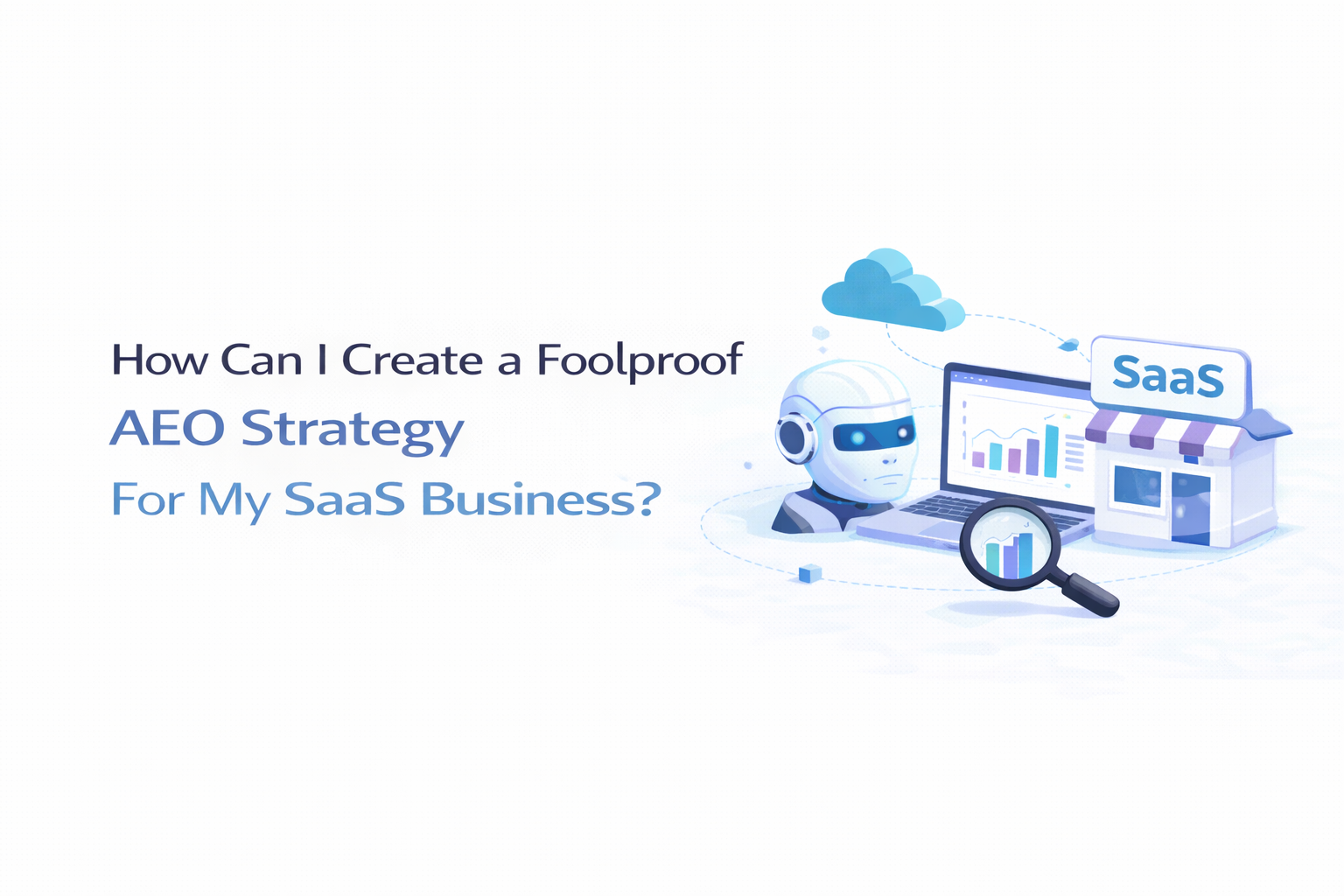
Everyone is talking about AI search these days. Because it is everywhere. As you type a question into Google, an AI overview pops up right at the top. If you are running a SaaS company, this change is huge. It is not just about ranking links anymore but it is about being the answer. This is where answer engine optimization matters.
This guide breaks down exactly how to build a SaaS AEO strategy that actually works. We are moving away from old school SEO and diving into what makes AI tick. Let us get your SaaS ready for the future of search.
What is Answer Engine Optimization (AEO) and Why Does It Matter for SaaS?
Answer engine optimization (AEO) is the practice of preparing your website content to be found and used by AI-powered search engines such as Google’s AI Overviews, Perplexity, and ChatGPT. Instead of just ranking for keywords, AEO focuses on directly answering user questions. For a SaaS company, this is huge.
As your potential customers are not just searching for CRM software. Instead, they are asking what is the best CRM for a small sales team? Or How do I integrate my email with a CRM? So AEO helps you show up as the direct answer to those questions.
The benefits of SaaS are clear. You get better search engine visibility and reach people who have a specific problem you can solve. This leads to higher quality traffic because people who find you are already looking for a solution like yours.
A recent Gartner study predicts that by 2028, organic search traffic will decrease by at least 50% as consumers embrace generative AI search. This is a massive shift.
People are talking to their devices more naturally. And your SaaS AEO strategy needs to reflect that. This is why a strong AEO approach makes sure you are part of that conversation.
How to Identify User Intent for AEO Success
To win at AEO, you need to know why someone is searching. Are they just looking for info, or are they ready to buy? This is why understanding user intent optimization is key.
For SaaS, intent usually falls into three buckets:
- Informational – What is a CRM?
- Navigational – HubSpot login page
- Transactional – Best CRM for small business 2026
For SaaS AEO strategy, you need to focus heavily on informational and transactional queries. Because AI engines love to answer questions that start with how to and what is.
Tools to help you dig deep
- Google Analytics – See what people are already typing to find you.
- SEMrush – Great for finding question based keywords.
- AnswerThePublic – Shows you the exact questions people are asking around your topic.
Examples of SaaS specific user intent queries
| Intent Type | User Query | SaaS AEO strategy Action |
| Informational | How to automate email marketing? | Create a step by step guide with clear headings. |
| Commercial | Mailchimp vs. Klaviyo for e-commerce | Create a comparison table with pros and cons. |
| Transactional | Buy email automation software | Ensure your pricing and features page is marked up with schema. |
When you nail user intent optimization, you stop writing for robots and start solving actual problems. And guess what? This is exactly what the robots want.
What is the Role of Structured Data in AEO for SaaS
Structured data is a way to label your website content so that search engines can better understand it. Think of it as giving search bots a roadmap to your information. For AEO, this is not just helpful, but it is important. Using structured data for SaaS helps AI engines quickly pull your information to generate rich results, such as review snippets and those handy answer boxes at the top of search results.
Implementing schema markup for SaaS is how you add this structured data. There are specific schemas that are very useful for SaaS businesses. These include,
- FAQ Schema – Mark up your frequently asked questions page so answers can appear directly in search results.
- Product Schema – Details your software’s features, pricing and reviews. This is perfect for transactional queries.
- How-to Schema – Breaks down step by step guides, making them easy for AI to feature.
According to Search Engine Journal, pages with schema markup have a 30% higher average click-through rate. This is free traffic you are leaving on the table if you do not use it.
You can use tools like Google’s Rich Results Test to check if your structured data for SaaS is working correctly. It is a simple check that saves you a lot of headaches later.
How to Optimize for Voice Search and Conversational Queries
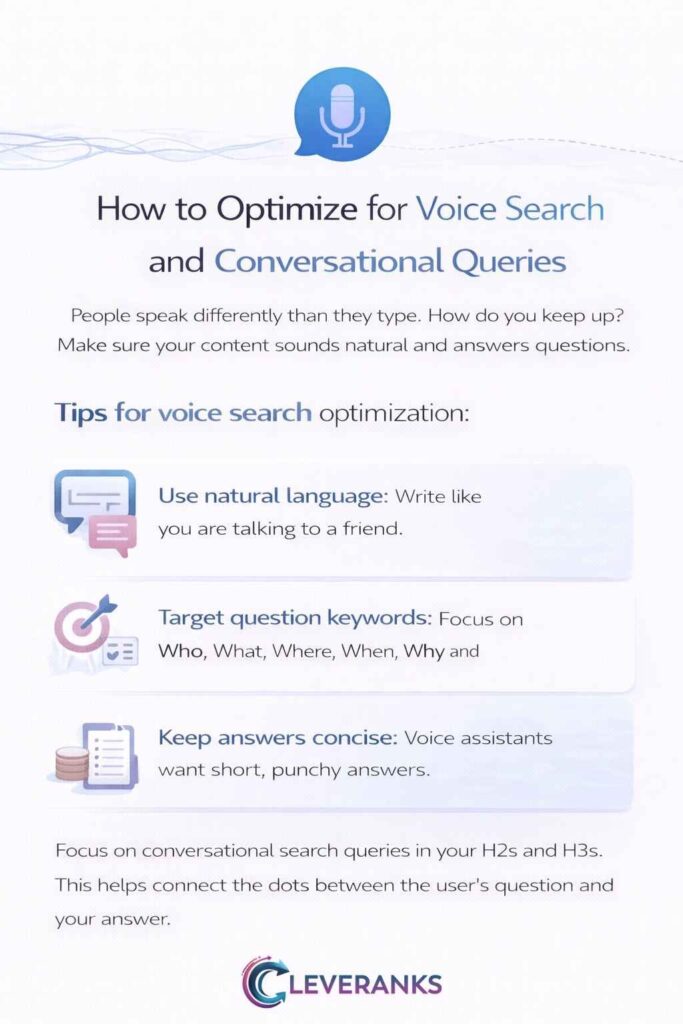
People do not type the way they talk. When typing, you might write as SaaS marketing tools. But when talking to Siri or Alexa, you might say something like, Hey, what are the best marketing tools for a SaaS startup?
This shift to conversational search queries means your content needs to sound natural. And it needs to flow. Voice search optimization is all about answering questions directly and simply.
Tips for voice search optimization:
- Use natural language – Write like you are talking to a friend.
- Target question keywords – Focus on Who, What, Where, When, Why, and How.
- Keep answers concise – Voice assistants want short, punchy answers (around 29 words is useful benchmark).
AI-powered search engines prioritize content that sounds human. If your content is stiff and full of difficult terms, it won’t get picked up for voice results. Even Aleyda Solis, International SEO Consultant says:
“Users arriving via ChatGPT linger longer, view more pages, and convert at higher rates than Google referrals.”
Focus on conversational search queries in your H2s and H3s. It helps the AI connect the dots between the user’s question and your answer.
How to Create High-Quality, AI-Friendly Content for SaaS
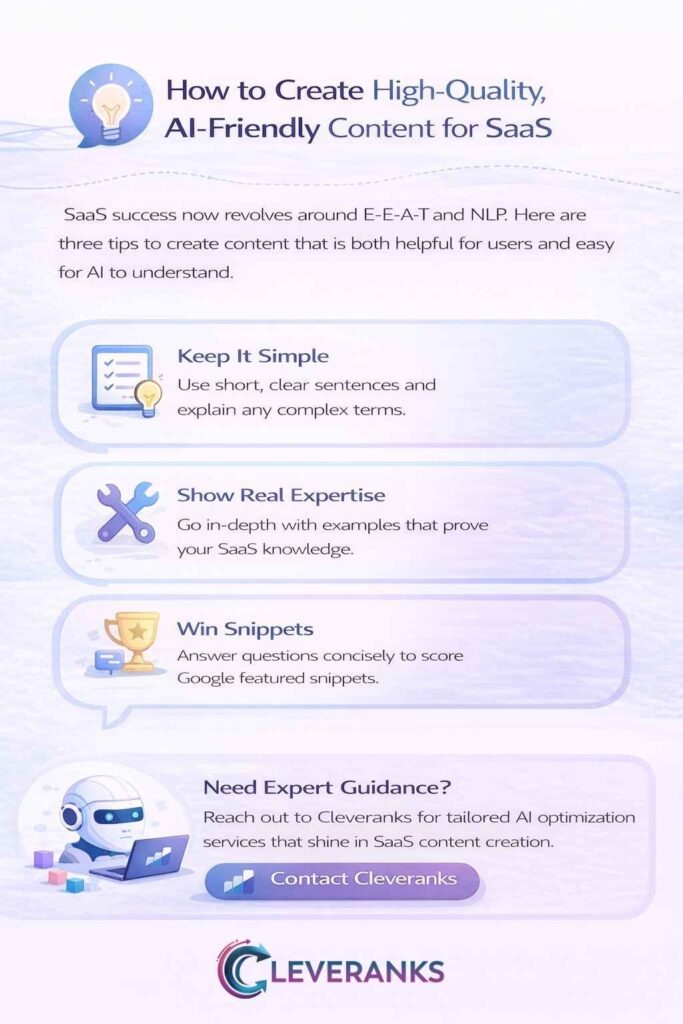
Content is still king, but the rules have changed. This is why you need to create content which is deep, relevant, and easy to read. SaaS content strategy now revolves around E.E.A.T (Experience, Expertise, Authoritativeness, and Trustworthiness).
Do not just fluff up a piece with keywords. AI search optimization means providing real value. If you are writing about churn rate, explain what it is, why it happens, and how to fix it, using real world examples.
Natural language processing (NLP) is how AI understands text. To optimize for Natural Language Processing (NLP):
- Use simple sentences.
- Avoid complex terminology unless you explain it.
- Use synonyms and related terms (LSI keywords).
Also, think about featured snippets. These are the little boxes at the top of Google search results. So winning these is a huge part of a solid SaaS content strategy.
How to Monitor and Measure Your AEO Strategy’s Success
You can not improve what you do not measure. This is why monitoring the success of your SaaS AEO strategy is crucial for making smart adjustments and proving its value. Instead of just tracking keyword rankings, you need to look at metrics that show how well your content is answering user questions.
Key AEO Metrics to Track
| Metric | What It Tells You | Tool to Use |
| Featured Snippet Rankings | How often is your content chosen as the direct answer? | Ahrefs, SEMrush |
| Voice Search Traffic | The volume of traffic from voice-activated devices. | Google Search Console |
| Organic Clicks to FAQ Pages | How many users are clicking on your structured FAQ answers? | Google Analytics |
| Question-Based Query Rankings | Your visibility for long-tail, conversational queries. | Google Search Console |
Regularly checking these metrics helps you understand what is working and what is not.
For example, if you notice a drop in featured snippets, it might be time to update that content or improve its structure. Continuous monitoring allows you to refine your AI search optimization efforts and stay ahead of the competition.
Which Tools Can Help You Build a Foolproof AEO Strategy?
You do not have to do this alone. There are tons of tools to help you streamline your SaaS AEO strategy.
- SEMrush – Great for keyword research and tracking featured snippets.
- Schema Pro – Makes adding schema markup for SaaS super easy if you use WordPress.
- AnswerThePublic – The king of finding conversational questions.
These tools simplify AI search optimization and help you focus on creating great content. They also help you align your SaaS content strategy with what users and AI-powered search engines are looking for.
How to Get Started with AEO for Your SaaS Business
Ready to dive in? Here is a simple plan to kickstart your SaaS AEO strategy.
- Audit your content – Look for opportunities to add structured data for SaaS.
- Target questions – Rewrite your H2s to include conversational search queries.
- Optimize for NLP – Ensure your content flows naturally and answers questions directly.
- Implement Schema – Use schema markup for SaaS on your key pages.
- Monitor results – Use tools to track your search engine visibility.
Common pitfalls to avoid
- Do not stuff keywords. It looks spammy, and AI hates it.
- Do not ignore the mobile. Most voice searches happen on phones.
- Do not forget the human. Write for people first, AI second.
Always show your expertise and build trust with your audience. If you need expert help navigating this process, an agency like Cleveranks can be your best choice. Before leaving, read the key takeaways of the article.
FAQs
What is the difference between SEO and AEO?
SEO (Search Engine Optimization) focuses on ranking websites in traditional search results. AEO (Answer Engine Optimization) is a newer approach that focuses on optimizing content to be the direct answer to a user’s question. AEO is critical for AI-powered search engines and voice assistants.
How can SaaS businesses optimize for voice search?
Focus on conversational, long-tail keywords. Then structure your content with Q&A formats. And use structured data for SaaS to help assistants understand your content. Also, make sure your site loads fast because speed is huge for voice.
What tools are best for implementing structured data?
Google’s Structured Data Markup Helper is free and great for generating the code. Schema Pro is excellent for WordPress users. Merkle’s Schema Markup Generator is another solid option for creating JSON-LD code for your SaaS AEO strategy.
Key Takeaways
- AEO is essential for SaaS businesses to stay competitive in AI-driven search environments.
- Understanding user intent, implementing structured data, and optimizing for voice search are critical components of a successful AEO strategy.
- Using the right tools and continuously monitoring performance can help SaaS businesses achieve long-term success.